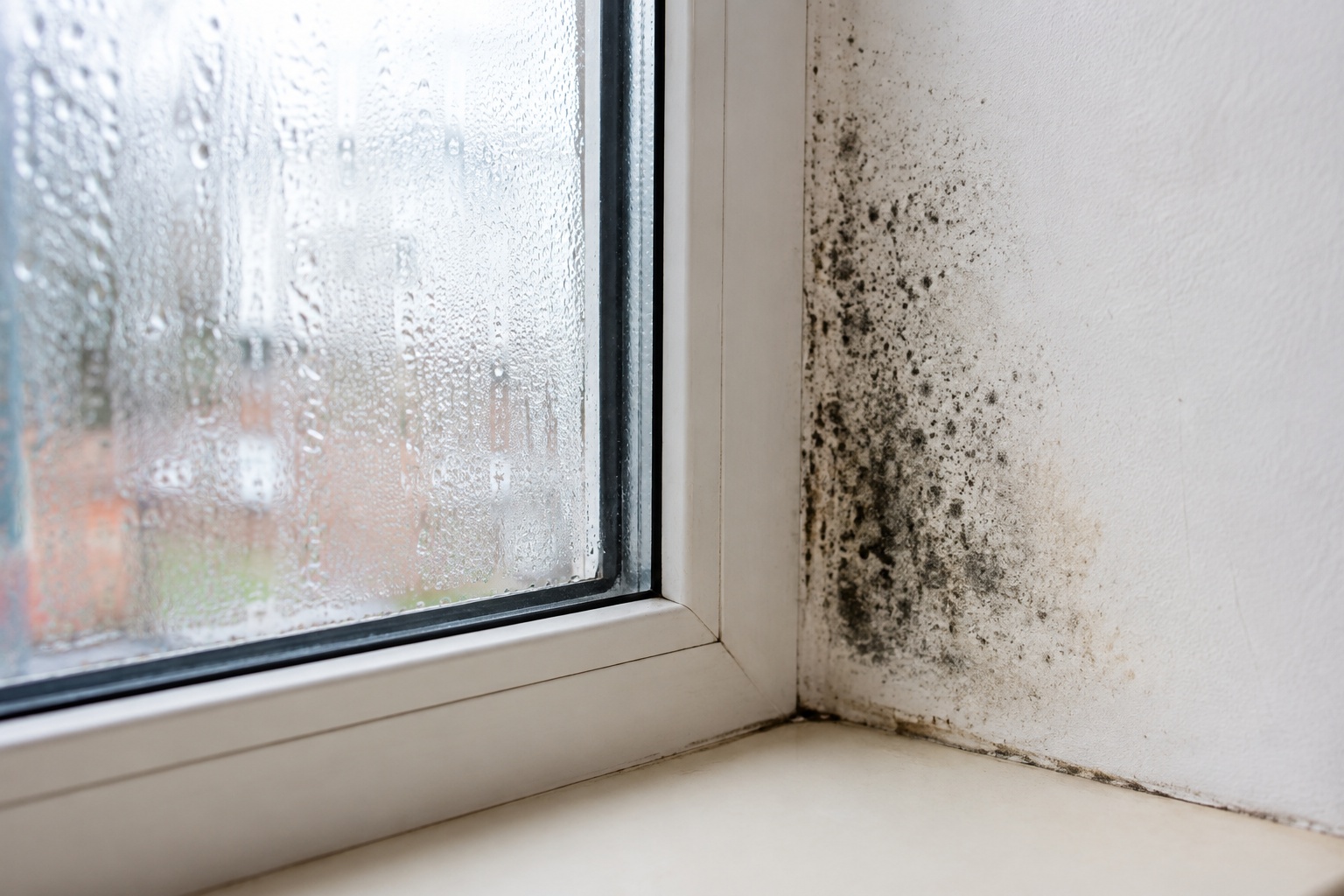

Modern Australian homes are being built tighter than ever — better insulation, better windows, less air leakage. But the same airtightness that keeps energy costs down also traps moisture and CO₂ inside. Without mechanical ventilation, the consequence is condensation, mould, and unhealthy indoor air.
The Airtight Home Problem
For most of Australia’s housing history, homes were unintentionally well-ventilated. Gaps in window frames, ceiling penetrations, and poorly fitted doors meant air moved in and out continuously — bringing fresh air and removing moisture without any mechanical assistance. This wasn’t efficient, but it was effective enough that mould and condensation were relatively uncommon in new homes.
Today’s construction is fundamentally different. Energy efficiency standards, combined with improved building products and techniques, have created homes that are genuinely airtight. This is excellent news for heating and cooling bills — but it creates a new problem: where does the moisture go?
A family of four generates up to 10–15 litres of water vapour per day through breathing, cooking, showering, and drying laundry. In an airtight home without mechanical ventilation, that moisture has nowhere to go.
What Happens Without Ventilation
When moisture can’t escape, it accumulates in the air until it finds a cold surface — a window frame, an external wall, the corner of a ceiling — where it condenses. If this happens regularly and the surface can’t dry out between condensation events, mould growth follows within days.
- Condensation on windows is typically the first sign — streaming down glass on cold mornings.
- Mould in bathrooms and bedrooms follows, especially in corners, wardrobes, and behind furniture against external walls.
- Musty smells develop as mould becomes established in wall cavities or ceiling voids.
- Health impacts emerge — respiratory issues, skin irritation, and sleep disruption from high CO₂ and mould spore exposure.
Why Exhaust Fans Aren’t the Answer
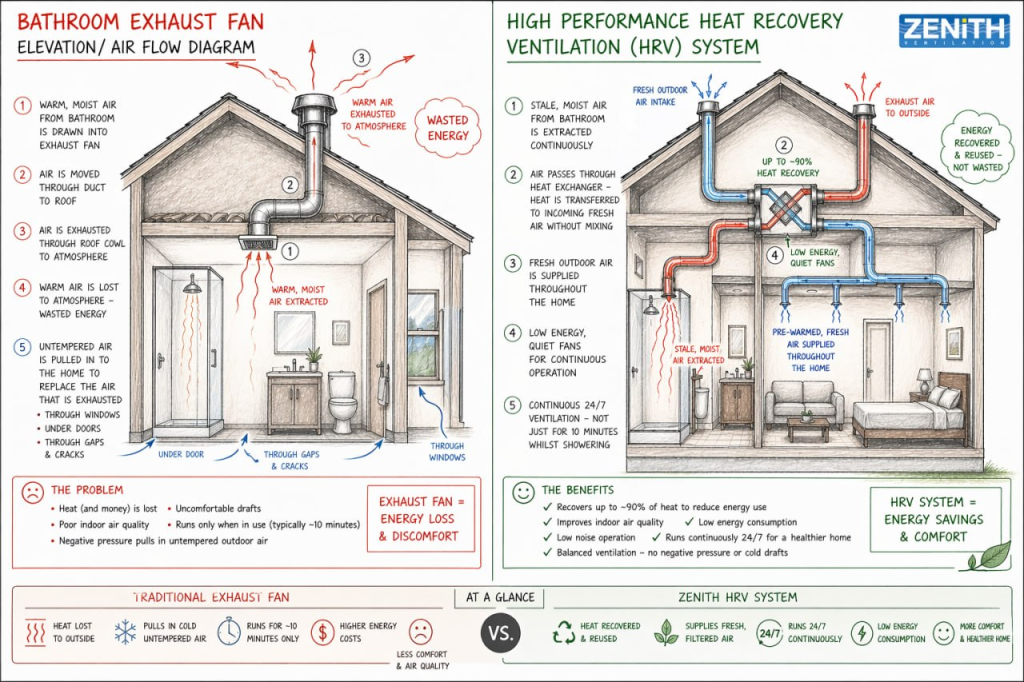
Many homeowners and builders respond to this problem by installing more exhaust fans — or running the existing ones more frequently. But this approach has a fundamental flaw: exhaust fans only remove air, they don’t replace it.
Every time an exhaust fan runs, it creates negative pressure in the home. That pressure is equalised by drawing air in from wherever it can — gaps around window frames, door seals, roof voids. In a genuinely airtight home, there may not be enough of these gaps to allow the fan to work effectively at all. And what air does come in is cold, unfiltered, and potentially just as humid as the air being removed.
The Solution: Mechanical Ventilation with Heat Recovery
MVHR — Mechanical Ventilation with Heat Recovery — was developed specifically for airtight buildings. Unlike exhaust fans, it doesn’t just remove air: it simultaneously supplies filtered fresh air to every room in your home, while extracting stale, humid air from wet rooms. The two air streams pass through a heat exchanger, where up to 90% of the heat energy from outgoing air is transferred to the incoming fresh air.
The result is a home that breathes continuously, 24 hours a day, without draughts, without noise, without manual intervention — and without the energy waste of simply throwing conditioned air out of the building.
- 52% Average indoor RH, held year-round
- 0 Mould recurrences since commissioning
- 2 Days to complete installation
- 2 Access holes required — both patched, painted